
Gen AI and Agentic AI
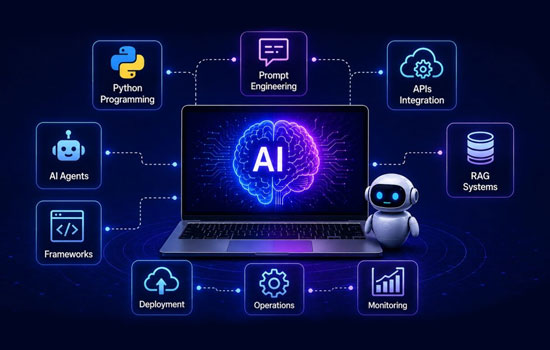
The Generative AI + Agentic AI Engineering Mastery curriculum is a structured 14-module learning program that guides learners from AI fundamentals to real-world implementation. Covering prompt engineering, Python, APIs, RAG, AI agents, frameworks, deployment, operations, and a capstone project, it builds practical skills, engineering discipline, and career-ready expertise for designing, deploying, and managing modern AI solutions confidently.
Course Rating :
4.8 (926)
Course Overview
This 14-module curriculum provides a structured journey through Generative AI and Agentic AI Engineering, covering AI foundations, prompt engineering, Python, APIs, LLM applications, embeddings, RAG, AI agents, frameworks, deployment, LLMOps, automation, and a capstone project. Learners develop practical implementation skills, engineering discipline, and the confidence to build, deploy, evaluate, and present modern AI solutions.
Course Curriculum
This curriculum is designed to move learners from AI awareness to implementation readiness in a controlled sequence: foundation, prompt discipline, Python/API readiness, LLM application development, embeddings, RAG, agents, frameworks, deployment, operations, automation, and capstone readiness.
Disciplined 14-Module Course Curriculum
A concise, module-wise curriculum derived from the RBCloudGenX executive course structure.
This version removes project noise and focuses only on the course content that must be covered
in Part I and Part II.
Curriculum Purpose
This curriculum is designed to move learners from AI awareness to implementation readiness in a controlled sequence: foundation, prompt discipline, Python/API readiness, LLM application development, embeddings, RAG, agents, frameworks, deployment, operations, automation, and capstone readiness.
| Topic | Description |
|---|---|
| Part I – Foundations to RAG and Agents |
M1: AI & GenAI Foundations M2: Prompt Engineering M3: Python & API Foundation M4: LLM Application Development M5: Embeddings & Vector Databases M6: RAG Engineering M7: Agentic AI Fundamentals |
| Part II – Frameworks, Ops, and Capstone |
M8: Tool Calling & Agent Tools M9: AI Frameworks M10: MCP & Multi-Agent Systems M11: AI Engineering & Deployment M12: LLMOps, GenAIOps & AIOps M13: No-Code AI Automation M14: Capstone Portfolio Project |
| Learning Ladder | L0: Awareness → L1: Prompt → L2: Build → L3: RAG → L4: Agent → L5: Operations (Ops) |
| Teaching Discipline | Every module includes concept explanation, key terminology, architecture overview, instructor demonstration, guided practice, common risks and mistakes, and clearly defined learner outcomes. |
Course Delivery Standard
| Topic | Description |
|---|---|
| Audience | Students, fresh graduates, IT professionals, data engineers, cloud engineers, QA engineers, software developers, and career changers seeking practical AI engineering skills. |
| Teaching Style | Begin with clear concepts, followed by key terminology, architecture overview, instructor demonstrations, guided practice, common mistakes, and measurable learning outcomes. |
| Depth Level | Progresses from foundational concepts to practitioner-level implementation, focusing on practical application rather than unnecessary research depth. |
| Tools | Python, Jupyter Notebooks, LLM APIs, vector databases, RAG tools, agent frameworks, deployment utilities, tracing and evaluation tools, and selected no-code AI automation platforms. |
| Exclusions | Avoid overwhelming learners with too many disconnected projects, excessive tool usage, or unnecessary theoretical concepts that do not directly support practical AI implementation. |
Curriculum Discipline and Learning Sequence
This page defines how the 14 modules should be delivered. The goal is structure, clarity, and execution readiness.
Standard Coverage Pattern for Every Module
| Teaching Component | Description |
|---|---|
| 1. Concept | Explain what the topic means in plain English before introducing technical concepts or implementation details. |
| 2. Terminology | Define only the essential terms learners need to communicate confidently and work effectively with AI technologies. |
| 3. Architecture View | Show where the topic fits within an AI system, including input, processing, models, data, tools, outputs, and monitoring. |
| 4. Instructor Demo | Demonstrate one clear, end-to-end workflow that directly supports the learning objective of the module. |
| 5. Controlled Practice | Allow learners to repeat or modify the demonstrated workflow through guided, hands-on practice. |
| 6. Common Mistakes | Highlight the most common errors learners make and explain practical strategies to prevent or resolve them. |
| 7. Learner Outcome | Conclude with a measurable capability statement describing what the learner should be able to accomplish after completing the module. |
High-Level Outcome by Phase
| Learning Phase | Description |
|---|---|
| Phase 1 – Foundation | Learners understand AI terminology, prompt structure, Python fundamentals, API basics, and the core mental model behind Generative AI systems. |
| Phase 2 – LLM Build | Learners understand how LLM applications are developed, how embeddings represent knowledge, and how RAG connects language models to trusted data sources. |
| Phase 3 – Agentic Systems | Learners understand AI agents, tool integration, frameworks, Model Context Protocol (MCP), multi-agent architectures, operational boundaries, and workflow orchestration. |
| Phase 4 – Delivery | Learners understand AI deployment, LLMOps, AIOps, no-code automation, production best practices, and portfolio presentation for career readiness. |
Recommended Flow
Do not start with tools. Start with mental models. Then move to prompts, APIs, data, retrieval, agents, frameworks, deployment, and operations. This prevents students from memorizing tools without understanding the system.
Part I - Foundations to RAG and Agents
Modules 1 and 2 establish AI literacy and prompt discipline. These two modules must be simple, strong, and confidence-building.
Goal: Build clean understanding of modern AI, GenAI, LLMs, AI agents, risks, and practical business relevance.
- AI vs ML vs deep learning vs GenAI.
- LLMs, tokens, context window, model behavior, hallucination.
- GenAI use cases: text, code, documents, search, assistants.
- AI agent meaning and how it differs from a chatbot.
- Responsible AI basics: accuracy, privacy, bias, safety, misuse.
- Where GenAI fits in enterprise workflows.
Outcome: Learners can explain GenAI clearly, identify realistic use cases, and speak the language of modern AI without confusion.
Goal: Teach learners how to communicate with LLMs in a structured, repeatable, and testable way.
- Prompt anatomy: role, task, context, constraints, examples, output format
- Zero-shot, few-shot, chain-of-thought style prompting without exposing private reasoning
- Prompt refinement, prompt debugging, and prompt comparison
- Output control: tables, JSON, summaries, bullets, structured formats
- Prompt safety: avoiding vague, biased, or over-trusting prompts
- Reusable prompt templates for business and technical tasks
Outcome: Learners can design prompts that are clear, structured, reusable, and suitable for business workflows.
| Section | Details |
|---|---|
| Area Coverage Required | Must cover AI vocabulary, Generative AI behavior, hallucinations, prompt structure, output control, and prompt iteration techniques. |
| Must Avoid | Do not begin with complex framework names. Avoid overwhelming learners with excessive AI models or advanced research terminology. |
| Completion Check | Learners should be able to explain Generative AI concepts and create a structured prompt for a business task with clear output expectations. |
Goal: Provide the minimum Python and API foundation required to build LLM-based applications.
- Python environment setup: notebooks, VS Code, packages, virtual environments
- Python basics needed for AI apps: variables, functions, lists, dictionaries, loops
- Files, JSON, environment variables, API keys, and configuration
- REST API basics: request, response, headers, status codes, payloads
- Working with Python libraries and reading documentation
- Error handling, logging basics, and clean notebook discipline
Outcome: Learners can run Python notebooks, call APIs, handle JSON, and prepare for LLM application development.
Goal: Move from prompting in a UI to building simple LLM-powered applications through APIs.
- LLM API request/response workflow
- Model selection basics: capability, cost, latency, context length
- Chat completion patterns and structured outputs
- Prompt templates, system instructions, and application-level context
- Input validation, response parsing, and error handling
- Building a simple LLM assistant flow from user input to model output
Outcome: Learners can build a basic LLM application flow using API calls, templates, and structured output handling.
| Topic | Description |
|---|---|
| Area Coverage Required | Environment setup, Python essentials, JSON, REST APIs, API keys, request/response flow, prompt templates, and structured outputs. |
| Must Avoid | Do not turn this into a full Python course. Focus only on the Python concepts required for AI application development. |
| Completion Check | Learners can run a notebook, call an LLM API, send input, parse responses, and handle basic API errors confidently. |
Goal: Teach how AI systems represent meaning and retrieve relevant information using semantic search.
- What embeddings are and why they matter
- Similarity search: semantic matching vs keyword search
- Chunking principles: size, overlap, boundaries, and meaning
- Vector indexes and vector database concepts
- Metadata design for retrieval filtering
- Common retrieval mistakes: poor chunks, weak metadata, duplicate content, stale indexes
Outcome: Learners understand how documents become searchable knowledge for RAG and AI assistants.
Goal: Teach how to connect LLMs with trusted knowledge so responses are grounded and explainable.
- RAG architecture: ingestion, chunking, embedding, indexing, retrieval, generation
- Document preparation and knowledge-base design
- Retriever design: top-k, similarity threshold, filters, reranking basics
- Grounded answering with citations and source references
- RAG evaluation: relevance, faithfulness, completeness, and failure analysis
- RAG risks: hallucination, stale data, irrelevant retrieval, over-trust
Outcome: Learners can explain and design a grounded RAG workflow from document ingestion to final answer.
Goal: Introduce agentic thinking: AI systems that can reason over a task, use tools, and execute workflows under control.
- Agent vs chatbot vs workflow automation
- Core agent components: model, instructions, tools, memory, state, planner, executor
- Planning and task decomposition
- Human-in-the-loop and approval checkpoints
- Agent boundaries: what agents should not do automatically
- Failure modes: loops, wrong tool use, over-execution, unsafe action
Outcome: Learners can describe agentic system design and identify where agents add value beyond simple chat.
| Topic | Description |
|---|---|
| Area Coverage Required | Embeddings, chunking, indexing, vector search, Retrieval-Augmented Generation (RAG) architecture, grounding, citations, agent components, planning, tools, and operational boundaries. |
| Must Avoid | Do not present RAG as a simple document upload process. Avoid portraying AI agents as fully autonomous or magical automation without planning, tools, and defined constraints. |
| Completion Check | Learners can explain how knowledge retrieval enables grounded, evidence-based responses and clearly distinguish AI agents from traditional chatbots. |
Part II - Frameworks, Ops, and Capstone
Goal: Teach how models interact with external tools, APIs, databases, files, and functions.
- Function/tool calling concepts and request lifecycle
- Designing tool schemas: name, description, parameters, validation
- Common tools: search, calculator, database lookup, document reader, API action
- Tool orchestration and deciding when a tool is needed
- Tool result handling and final answer synthesis
- Security controls: permissions, validation, audit, human approval
Outcome: Learners can design safe tool-enabled AI workflows and understand how agents connect to external systems.
Goal: Give learners a structured understanding of major AI engineering frameworks and when to use them.
- Framework purpose: abstraction, orchestration, retrieval, agents, tracing
- LangChain concepts: chains, tools, retrievers, memory patterns
- LangGraph concepts: state, nodes, edges, workflow control
- LlamaIndex concepts: data connectors, indexes, query engines
- OpenAI Agents SDK concepts: agents, tools, handoffs, tracing
- Framework selection: when to use plain API vs framework
Outcome: Learners can compare frameworks and select the right engineering approach instead of blindly using tools.
Goal: Teach context-sharing and multi-agent coordination patterns for complex AI workflows.
- MCP purpose: connecting models to tools, data, and context through standard interfaces
- Client, server, tools, resources, prompts, and context boundaries
- Multi-agent roles: specialist, supervisor, reviewer, router, executor
- Handoffs, routing, delegation, and result consolidation
- Coordination risks: conflicting outputs, duplication, loops, cost explosion
- Governance: observability, permissions, and human review
Outcome: Learners understand how context protocols and multi-agent patterns support scalable AI workflows.
| Topic | Description |
|---|---|
| Area Coverage Required | Tool schemas, tool result handling, framework purpose, LangChain, LangGraph, LlamaIndex, OpenAI Agents SDK, Model Context Protocol (MCP), and multi-agent design patterns. |
| Must Avoid | Do not teach frameworks as brand names alone. Explain when to use a plain API, a RAG framework, an agent framework, or graph-based orchestration for different AI application scenarios. |
| Completion Check | Learners can choose the most appropriate framework pattern and explain how to design a secure, reliable, and tool-enabled AI workflow. |
Goal: Teach the engineering discipline required to move from a notebook/demo to a usable application.
- Application structure: frontend, backend, services, configuration, secrets
- Streamlit for quick AI application interfaces
- FastAPI for API-based AI services
Packaging code, dependency management, and environment files - Docker basics for repeatable execution
- Deployment thinking: local, cloud, authentication, logging, scaling basics
Outcome: Learners can explain the path from prototype to deployable AI application with clean engineering structure.
Goal: Introduce operational discipline for evaluating, monitoring, improving, and governing AI systems.
- LLMOps lifecycle: prompts, datasets, evaluations, releases, monitoring
- Tracing model calls, tool calls, latency, cost, and errors
- Evaluation types: exactness, relevance, faithfulness, safety, user satisfaction
- Guardrails: input checks, output checks, policy checks, escalation
- Feedback loops and continuous improvement
- AIOps overview: using AI for operational detection, summarization, triage, and automation
Outcome: Learners can apply operational thinking to make AI systems measurable, reviewable, and improvable.
Goal: Show how non-developers and business teams can use AI automation responsibly for productivity workflows.
- No-code and low-code automation concepts
- Trigger-action workflows and AI-assisted steps
- Document, email, form, spreadsheet, and notification automation patterns
- When no-code is appropriate vs when custom engineering is required
- Controls: approval steps, audit trails, access, privacy, and rollback
- Productivity use cases for operations, support, analytics, and training
Outcome: Learners can identify useful no-code AI automation opportunities and understand their limitations.
| Topic | Description |
|---|---|
| Area Coverage Required | Streamlit, FastAPI, Docker, application packaging, deployment patterns, evaluation, tracing, monitoring, guardrails, user feedback, and no-code automation tools. |
| Must Avoid | Do not present a notebook as a production application. Ensure learners understand the importance of evaluation, logging, security, monitoring, and operational risk management. |
| Completion Check | Learners can explain the key requirements for transforming an AI prototype into a deployable, scalable, secure, and monitorable production solution. |
Goal: Bring the full learning path together into one polished, explainable, career-ready solution.
- Problem statement and business context
- Architecture: UI, LLM, retrieval, tools, data, evaluation, deployment plan
- Implementation plan: milestones, components, risks, and validation
- Evaluation: test cases, expected outputs, quality checks, limitations
- Portfolio packaging: README, architecture diagram, demo script, resume bullets
- Final presentation: problem, solution, architecture, demo, lessons learned
Outcome: Learners can present a complete AI solution with architecture clarity, implementation confidence, and portfolio value.
| Topic | Description |
|---|---|
| Core Concepts | AI, Generative AI, LLMs, prompts, tokens, hallucinations, embeddings, vector search, Retrieval-Augmented Generation (RAG), AI agents, tools, frameworks, Model Context Protocol (MCP), deployment, and AI operations. |
| Core Skills | Prompt design, API integration, Python fundamentals, structured outputs, retrieval design, agent design, framework selection, and evaluation thinking for real-world AI applications. |
| Engineering Mindset | Design before coding, validate before trusting, monitor before scaling, and explain solutions clearly before presenting them. |
| Career Outcome | Learners can confidently discuss AI systems, demonstrate implementation awareness, and present a complete AI solution with technical clarity. |
| Instructor Rule | Keep every session aligned with the module outcome. Avoid unnecessary tool overload, excessive projects, and theoretical concepts that do not directly support practical learning. |
End State
At the end of the 14 modules, the learner should not merely know AI terminology. The learner should understand how modern AI systems are designed, built, retrieved, orchestrated, evaluated, deployed, monitored, and explained.
Enroll Free Demo Class
Enroll Free Demo Class
Have Any Questions ?
- 521 Dyson Rd HainesCity FL 33844
- info@rbcloudgenx.com
- +1 8043007153
Prerequisites
This program is designed for beginners as well as professionals who want to build practical AI engineering skills. While no prior AI experience is required, learners will benefit from having:
- Basic computer and internet navigation skills
- Familiarity with using web applications and online tools
- Basic logical and problem-solving abilities
- A willingness to learn Python fundamentals (covered during the course)
- A laptop or desktop with a stable internet connection
- Basic understanding of English technical terminology
Our Other Courses
This comprehensive MLOps course is designed to bridge the gap between data science and operations. By the end of this course, participants..
Data Science is an interdisciplinary field that combines statistical analysis, machine learning, and domain expertise to extract insights from data.
This comprehensive Power BI course is designed to equip learners with the skills and knowledge to transform data into actionable insights.
This comprehensive Tableau course covers both Tableau Desktop and Tableau Server, providing participants with the skills to visualize.
Rate This Course !
Click on a star to rate it!
Average rating 4 / 5. Vote count: 2
No votes so far! Be the first to rate this post.